Category: Tech

Stay updated with Technology News and Science-related Articles covering AI, cybersecurity, gadgets, software, and digital innovation shaping the future.

  • Why Leading Brands Trust SEO Services Consultants for Long-Term Digital Growth

    Why Leading Brands Trust SEO Services Consultants for Long-Term Digital Growth

    In the present day and in a very competitive digital environment, every brand, regardless of its size, works hard to get noticed online. Based on my research, the most successful brands do not solely depend on paid ads, but they also hire SEO consultants for reliable and gradual growth. SEO, unlike other marketing tactics, builds up the whole thing, that is, it continually attracts organic traffic, creates trust, and enhances the visibility of the brand.

    The Necessity of SEO in a Brand’s Digital Journey

    Through my research, I have found that in the past search engine optimization was limited to the mere placement of keywords. Today, it is a complete digital strategy that touches every point of online visibility—from the structure of the website to the quality of the content and even user experience.

    A search engine optimization company not only guarantees a brand higher ranking on Google but also on Bing and other search platforms. Visibility for the brand to the audience is not the only thing that this tactic does, but it also results in better audience engagement and consequently higher conversion rates. 

    Partnering with an SEO firm means that the company will be able to get data-backed insights, thus they will be able to adapt quickly to the changing market trends and algorithm updates. From what I know, the companies that make consistent investments in SEO are the ones reaping more benefits as time goes by, compared to those using paid campaigns whose results would vanish as soon as the budget is cut.

    Why Leading Brands Choose SEO Services Consultants

    The leading brands are aware that SEO consultants provide more than just technical expertise—they think strategically. SEO consulting service is such a powerful and effective way that the top brands are able to pay the big bucks just to get into the consultant’s book because companies trust the consultant’s professional support and guidance, which is likely to have a substantial benefit in terms of visibility and credibility.

    1. Expertise and Experience

    SEO consultants have been found by my study to be in possession of not just years but decades of experience in handling intricate projects in varied industries. Their mastery gives them the power to spot difficulties, predict trends, and draft custom strategies that are in line with brand goals.

    2. Long-Term Value Creation

    SEO, in contrast to short-term digital campaigns, brings continuous value. The search engine optimization services firm is always there to reap the benefits of website performance upgrades, domain authority increasing, and legitimate link building done all along. This gradually forms a sturdy base for digital supremacy.

    3. Data-Driven Decision Making

    Today’s modern tools and analytics have made the work of SEO optimization consultants very easy as they can provide actionable insights. They look into keyword trends, user behavior, and conversion metrics so as to make decisions based on facts. According to my research, data-backed SEO strategies allow brands to outdo their rivals even in the most crowded markets.

    4. Holistic Digital Growth

    The professional search engine optimization agency is not just there to improve the ranking. It brings about a complete overhaul of the online ecosystem—technical health, content strategy, and brand authority. Such a comprehensive method guarantees that the increase in business is not only noticeable but also lasting.

    The Role of SEO Consulting Firms in Digital Transformation

    My market research has shown that the demand for SEO consulting firms has gone up significantly because the brands are progressively moving toward the digital transformation that is not only technologically advanced but also sustainable. Thus, in this case, such firms are the strategic partners by introducing businesses to the intricacies of search algorithms, market competition, and consumer behavior.

    1. Strategic Planning and Roadmapping

    The very beginning of every successful SEO journey is a clear roadmap. The SEO consulting agencies carry out full-fledged audits to find out the things they can improve upon and set goals that can be measured. The whole process of planning will make sure that all the effort put into optimization will be directed towards the business objective.

    2. Content Optimization for Brand Authority

    Content that is of the highest quality and has the most relevance is still the most important factor in SEO. According to me, the services of SEO optimization have a great impact on content by matching it with the intent of users and the trends in searching. What this does is increase not only the rankings but also the trust and credibility with the audience which is the ultimate goal of every brand.

    3. Continuous Monitoring and Performance Tracking

    SEO is not a one-time job but a consistent effort that requires the monitoring of the entire process continuously. The experts in SEO management consulting follow the performance metrics such as organic traffic, click-through rates, and bounce rates to make sure that the strategies are still effective. Throughout the process, optimization keeps the brands one step ahead of the competition.

    How SEO Services Company Enhances Long-Term ROI

    From my studies, one of the most important benefits of appointing an SEO services firm is the high ROI it brings. SEO works in such a way that the returns are compounded over time as opposed to paid media. When your site starts getting more and more traffic through the search engines, it would not incur the ad costs that you have to pay for continually.

    1. Cost Efficiency

    Even though the cost of SEO at first may look more than that of PPC, the final output validates the investment. A good search engine optimization company makes sure your site is no longer a ghost that only gets to be seen for a while by leads and conversions through the very initial optimization.

    2. Better Conversion Rates

    SEO improves the number of conversions through optimizing user experience, website speed, and content relevance. When the visitors do not have to struggle to find what they need, they are not only likely to engage but also to buy. The services of a Search Engine Optimization consultant are primarily concerned with developing and implementing conversion strategies.

    3. Sustainable Brand Awareness

    SEO is the very foundation of a company’s online branding. Market research that I have done shows that the brands with good positions in the organic search results enjoy a steady growth in their recognition and trust. A good SEO consulting firm will make your brand visible to your desired audience even in highly competitive niches.

    The Strategic Role of SEO Consultants in Brand Success

    A professional SEO consultant is indispensable in integrating a company’s marketing vision with measurable performance objectives. These consultants give an external and unbiased point of view which is very helpful in spotting the company’s weaknesses and suggesting solutions that the internal teams may not have thought of.

    1. Competitive Analysis and Benchmarking

    Based on my research, SEO consulting firms conduct extensive competitive analysis to comprehend the market dynamics. They spot the gaps and opportunities by comparing them with the industry leaders, and thus your brand is given a competitive advantage.

    2. Aligning SEO with Business Goals

    The experienced SEO consultants always make sure that the lead generation, sales growth, and customer retention which are the key performance indicators, are the same with every action that is taken. This transformation of SEO from a digital marketing tactic to a strategic growth driver is made possible through this alignment.

    3. Technical and On-Page Excellence

    Websites that are technically sound get rewarded by search engines. Consultants make sure that all on-page and technical SEO factors such as site architecture, schema markup, and internal linking are optimally done for the search engine crawlers.

    Future-Proofing Your Brand with SEO Management Consulting

    In my opinion, the digital world is in constant change. The new search engine algorithms, the development of novel technologies, and the diversity of user behaviors are the factors that always need the adaption of the companies. It is during such times that SEO management consulting becomes indispensable.

    SEO consultants keep your business in the future by adjusting the strategies, following the new trends, and tweaking the tactics to stay at the top ranking continually. Their proactive stance means that your brand not only survives but also flourishes in the midst of digital disruptions.

    Conclusion: Relying on Professionals for Digital Growth that Lasts

    To sum up, as I have done research and market studies, the top brands in the world rely on SEO services consultants because they provide results that are measurable and sustainable in the long run. Working with an SEO agency that you can trust turns your digital presence from being reactive to being strategic.

    The professionals in the field mix data, creativity, and tactics to ensure your brand’s continuous growth. When a business decides to invest in professional SEO consulting firms, it gets the chance to benefit from organic marketing to the maximum extent, which means that the business will be more visible, credible, and profitable in the long run.
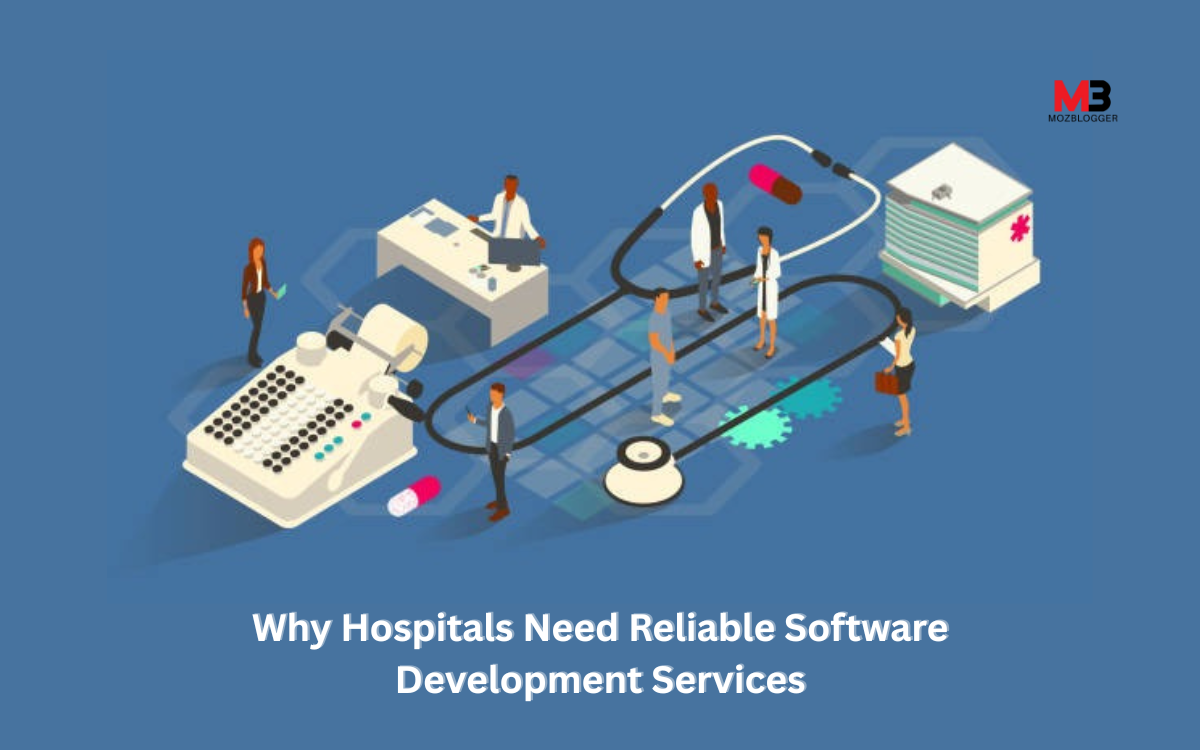

  • Why Hospitals Need Reliable Software Development Services

    Why Hospitals Need Reliable Software Development Services

    In today’s healthcare landscape, hospitals are under immense pressure to deliver high-quality patient care while managing growing administrative demands. From electronic health records to telemedicine apps, every process now depends on digital solutions. This is why reliable software development services are not just a technical necessity, they are the foundation of efficient, secure, and patient-centric healthcare operations.

    1. Streamlining Day-to-Day Hospital Operations

    Modern hospitals handle an enormous amount of data every day appointments, patient histories, prescriptions, lab results, and billing. Without integrated software systems, managing this data manually can lead to delays, errors, and inefficiency.

    By partnering with experts in software development services , hospitals can automate repetitive administrative tasks, ensuring better coordination across departments. Features like centralized dashboards, role-based access, and real-time analytics simplify internal workflows and reduce manual dependency.

    2. Improving Patient Care Through Digital Systems

    At the heart of healthcare lies patient care, and software plays a major role in improving its quality. From online appointment scheduling to remote consultations, digital tools have made healthcare more accessible and transparent.

    Customized healthcare software development services enable hospitals to create patient portals, telehealth platforms, and medical data management systems that help doctors and patients connect more efficiently. Such tools not only reduce waiting times but also enhance patient satisfaction and engagement.

    3. Enhancing Data Security and Compliance

    Patient data is one of the most sensitive forms of information. Hospitals must adhere to strict data protection laws like HIPAA, GDPR, and other regional healthcare regulations. Breaches or unauthorized access can result in legal penalties and loss of trust.

    Reliable development partners ensure that hospital software is designed with robust security protocols—end-to-end encryption, access control, and regular vulnerability testing. Specialized healthcare software development services prioritize compliance and data sovereignty, ensuring that patient information stays protected at all times.

    4. Building Interoperable Systems for Seamless Collaboration

    Hospitals often rely on multiple systems—EHR, pharmacy management, radiology, and billing platforms. Without interoperability, data silos emerge, creating bottlenecks in communication and treatment planning.

    Through professional software development services, these systems can be integrated into a single ecosystem. Interoperability ensures that patient information flows securely between departments, helping doctors make faster and more informed decisions.

    5. Supporting Remote and Real-Time Access

    Healthcare no longer happens only within hospital walls. Doctors, nurses, and administrators need secure remote access to information and tools, especially in the age of telemedicine and remote patient monitoring.

    By leveraging cloud-based healthcare software development services, hospitals can deploy scalable platforms that provide real-time access from any device or location. This flexibility supports continuity of care, especially during emergencies or off-site operations.

    6. Ensuring Scalability for Future Growth

    As hospitals grow, their technological needs evolve. A reliable development partner ensures that systems are scalable—ready to accommodate more users, new departments, and advanced functionalities without disruption.

    Engaging professional software development services ensures that the technology infrastructure grows in sync with the hospital’s operations. Whether adding AI-based diagnostics or integrating wearable health devices, scalable systems future-proof your healthcare ecosystem.

    7. Reducing Long-Term Costs and Downtime

    While many hospitals hesitate to invest in custom software initially, the long-term benefits far outweigh the costs. A reliable development team builds efficient systems that minimize downtime, reduce manual work, and prevent costly data errors.

    In the long run, optimized systems developed through healthcare software development services can save significant resources by streamlining workflows and automating maintenance updates.

    Conclusion

    Reliable software isn’t just about performance—it’s about trust, accuracy, and patient-well-being. Hospitals that invest in dependable software development services build a strong digital backbone that supports better care, compliance, and innovation.

    Interestingly, a recent discussion in the tech community highlighted how AI is transforming high-volume hiring by helping recruiters overcome resume overload through smart automation and intelligent filtering. The same principle applies in healthcare — reliable, data-driven software helps hospitals process massive volumes of patient data quickly, allowing doctors and staff to focus on what truly matters: quality care.

    In both cases, success comes down to scalable, intelligent, and secure systems. Hospitals that choose experienced healthcare software development services not only streamline their workflows but also future-proof their digital infrastructure for an era driven by data and innovation.

  • Code Coverage Reporting and Visualization Best Practices

    Code Coverage Reporting and Visualization Best Practices

    Have you ever waved a green test‑coverage report, only to find bugs slipping through to production anyway? It happens more than you think. Just because you have a high percentage of code coverage does not mean that your tests are useful or that your software is safe. This gap has arisen because code coverage data is raw and underutilized: people generate numbers and dashboards, but they do not unlock the numbers to provide insight. That’s the issue we are working through here.

    In this article, we will demonstrate how to translate the code coverage metrics into meaningful reports and visualizations that aid in your decision‑making, improve test suites, and align with quality. You will learn what to track, how to visualize it, what not to do, and how tools and practices can sugarcoat in-transparency into your testing ecosystem.

    Why Code Coverage Is More than Just a Percentage?

    Code coverage is a measure of how much of your codebase you exercise with tests—but just meeting code coverage goals (for example, 80 % line coverage) creates a false sense of security, without context:
    You may be covering trivial code paths while missing high‐risk logic.

    You may be unaware of new code that is not tested.

    You may not see gaps like untested branches, database logic, or integration points.

    Ultimately, a number cannot tell you what it is covering, why it matters, or what to do next. Reporting and visualization provide that – converting raw data into knowledge.

    Important Measures for Code Coverage Reporting

    When crafting reports, consider these measures:

    Line, Branch, and Condition Coverage

    Line coverage: percentage of lines run.
    Branch coverage: whether true/false branches in control statements are tested.
    Condition/decision coverage: more granular (e.g., composite boolean expressions). Tracking all three provides visibility into simple execution, logical branching, and complex decision-making.

    Coverage Delta for New or Changed Code

    Track reporting delta related to new or changed code (“hot code”). High coverage of other code you have written does not eliminate risk in newly added (untested) code. Provide a delta on coverage that allows the team to focus on change quickly.

    Risk-Based Coverage

    Not all code is the same. Certain modules carry more risk (payment processing, authentication, core domain logic). We should think of reporting desired coverage mapping against risk categories vs. completing reporting based on the similarity of each code block.

    Test Execution and Coverage Over Time

    A dramatic coverage spike on one day does not indicate stability. Viewing coverage trends, or whether coverage is increasing or decreasing, or the execution flakiness trend, is a better gauge of test health and how the code base is adjusting over that time span.

      Effective Visualization Techniques

      Visualization is effective because humans do a better job interpreting visual information and trends than written numbers in a table. Here are the best examples of effective visualizations.

      Visualization Maps and Coverage Maps

      A visual representation of your codebase (the folders, files, and modules of code) that indicates the level of coverage with “shading” allows the reader (stakeholder) to see “cold zones” (areas of the code with low coverage) visually at a glance.

      Dashboards that Support Drill-Down Capabilities

      Use dashboards that allow the viewer to “drill down” into the data: overall coverage –> module coverage –> file coverage –> test case link. Enabling interactive dashboards allows IT teams to strategically “move from visibility to action.”

      Trend Charts and Alerts

      Display the percentage of coverage over time and annotate the spikes or dips. Link the spikes and dips to releases or test suites. Keep a list of flags (e.g., if coverage drops > 2%) so that the parents get alerted instead of waiting to see when they naturally monitor.

      Annotated Coverage Reports for Pull Requests

      Add coverage checks in PRs so that developers can see the coverage delta, see which new code is untested, and fix before the merge. This builds a visual feedback loop to embed quality into development.

      Reporting and Visualization Best Practices

      Think of your coverage objectives as tied to business value: You should set your objectives reflecting risk and impact, not mere percentages.

      • Consistent definitions and tooling: Ensure that the same definitions are used across teams to make reporting useful and comparable.
      • Actionable reporting: A quality report addresses: What coverage has regressed? Why did it regress? What should I focus on?
      • No more celebrating vanity metrics: 100% line coverage is not a win unless you can prove meaningful quality tests.
      • Reporting should live in CI/CD: Coverage should flow automatically from build/test into your dashboards.
      • Review and prune your tests regularly: Coverage reports may provide feedback on which tests are redundant or obsolete, and without those tests, you will have clarity without maintenance.
      • Add user-run workflows: Covering data in concert with observability or real usage (e.g, recorded user flows) will give more precise confirmation of what actually matters in production.

      Practical Tooling and Process Integration

      To bring coverage reporting to life:

      • Choose a coverage tool that fits into your tech stack (e.g., JaCoCo if you’re in Java, Istanbul/nyc if you’re in JavaScript, Coverage.py if you’re in Python).
      • Use visual dashboards or plugins to visualize raw reports (e.g., SonarQube, Report‑Generator).
      • Put coverage checks into your CI pipeline so every build publishes results and identifies regressions.
      • Create PR gates, i.e. you can’t drop coverage by below X% or X% coverage for new code.

        Typical Mistakes to Avoid

        Looking only at total coverage: That coverage value is misleading, without context.

        • Ignoring legacy code: More code that is older has a completely different risk profile, since it often has fewer tests.. Keep legacy code testing a priority.
        • Tests that overlap and count coverage: Duplicate tests can create false coverage, without bringing any value. Check the coverage reports for duplicates.
        • Coverage falloffs go unrecognized: You may go weeks or months without realizing that you dropped in coverage significantly, unless an issue gets flagged. Set some sort of alerts.
        • Too many visualizations: Too many dashboards or a poorly designed dashboard can confuse rather than clarify., Focus on clarity and getting something actionable out of each visualization.

        Conclusion

        When you report, visualize, and effectively communicate code coverage data, you change a raw statistic into a strategic weapon in your effort to assure quality. If executed correctly, you get a clear view into the areas your code base is tested, potentially vulnerable, and where you want to point your focus next. When you align coverage to business risk, use intuitive dashboards, utilize CI/CD workflow, utilize Keploy, and test against real-user scenarios, you are building confidence and agility into the testing process. Remember, this is not a race to a number, but rather, it’s a concerted effort to inform, inspire action, and improve software quality over time.

      1. Apple Macbook Pro M5 Chip – Full Info

        Apple Macbook Pro M5 Chip – Full Info

        The Apple MacBook Pro with the M5 chip represents the next generation of Apple’s high-performance laptop, featuring the company’s custom-designed Apple Silicon M5 System-on-a-Chip (SoC). Announced in October 2025, this machine is positioned as a significant leap forward, particularly in the realm of Artificial Intelligence (AI) and graphics performance.

        The M5 Chip: A Leap in AI and Graphics

        The M5 chip is the central innovation, built on third-generation 3-nanometer technology for enhanced power efficiency and performance. Apple has heavily emphasized the M5’s AI capabilities, dubbing it “the next big leap in AI for the Mac.”

        Core Technological Advancements

        • Neural Accelerator in Each Core: A key architectural change in the M5’s 10-core GPU is the integration of a Neural Accelerator in every core. This design choice is what drives the massive increase in AI performance, which Apple claims is up to 3.5x faster than the previous-generation M4 chip for AI workloads.
        • Enhanced Performance: The chip also features a faster and more efficient CPU with an advanced core architecture, offering up to 15% faster multithreaded performance over the M4. Graphics performance is also boosted, with up to 1.6x faster graphics than the M4, and the inclusion of a third-generation ray-tracing engine.
        • Faster Neural Engine: The 16-core Neural Engine itself is improved, further accelerating machine learning tasks and on-device AI features like those found in the new Apple Intelligence suite, enabling smoother execution of large language models (LLMs) locally.
        • Unified Memory Bandwidth: The M5 offers a notable increase in unified memory bandwidth, accelerating everything from app launches to handling large files.

        MacBook Pro Design and Features

        The initial launch focused on the 14-inch MacBook Pro with the base M5 chip, maintaining the familiar premium Liquid Retina XDR display and chassis design, available in Space Black and Silver.

        Key Laptop Specifications

        • Battery Life: One of the most significant user-facing improvements is the phenomenal battery life, soaring up to 24 hours on a single charge.

        • Storage and Speed: The new model features up to 2x faster SSD performance than the previous generation, improving workflows involving large data transfers, such as importing RAW images or exporting high-resolution video. Configuration options allow for up to 4TB of storage and 16GB of unified memory as standard.

        • Operating System: The M5 MacBook Pro runs on macOS Tahoe, which introduces a refined user interface and deep integration with Apple Intelligence features.

        1. Structure Your Accomplishments (Action-Result-Metric)

        Every bullet point in your work experience section should be an achievement, not a passive duty. Use the Action-Result-Metric (ARM) method to structure your statements:

        • Action Verb: Start strong (e.g., Led, Spearheaded, Optimized, Delivered, Reduced).
        • Result/Project: What did you do and for what project?
        • Metric (The Quantifier): What was the measurable outcome? Use numbers, percentages, budgets, and timeframes.
        Generic DutyQuantifiable Accomplishment (ARM)
        Managed the company’s annual budget.Managed a $2.5 Million annual IT budget, consistently delivering projects 3% under budget across the portfolio.
        Implemented a new project methodology.Spearheaded the transition to an Agile methodology for the Product team, reducing project delivery time by 20% and boosting team velocity by 35%.
        Coordinated with vendors and stakeholders.Negotiated new vendor contracts for a major infrastructure upgrade, generating $400K in annual savings and improving service uptime to 99.9%.

        2. Craft a Powerful Professional Summary

        Your summary is your 3-4 sentence elevator pitch. It should immediately highlight your most impressive, quantifiable achievements and relevant industry experience.

        Example Summary:

        Results-driven Technical Project Manager (PMP) with 7+ years of experience leading cross-functional teams and delivering high-value software projects. Successfully managed a portfolio valued at over $12M, consistently achieving a 98% on-time delivery rate. Expertise in Agile/Scrum transformation, risk management, and vendor negotiation, resulting in a 15% reduction in operational costs through process optimization.

        3. Emphasize Key Metrics Across the Project Lifecycle

        To demonstrate comprehensive project management skills, your bullets should cover the full lifecycle and various domains:

        DomainKey Quantifiable Achievements
        Schedule & TimeReduced project turnaround time by 15% with streamlined task management workflows. Delivered the flagship product launch 2 months ahead of schedule with zero critical defects.
        Cost & BudgetOversaw a $5 Million infrastructure project, completing it 12% under budget by optimizing resource allocation. Cut annual software licensing costs by $50,000 through strategic license review.
        Process & EfficiencyImplemented a new ticketing system for the IT department, improving average response time by 30%. Streamlined the QA process, reducing post-launch errors by 35%.
        Leadership & TeamLed and mentored a global team of 15+ developers and designers, resulting in a 10% increase in team productivity (velocity).
        Stakeholder/ClientIncreased client satisfaction by 25% by improving communication and collaboration protocols via weekly status reports.

        4. Include Relevant Certifications and Tools

        Recruiters use Applicant Tracking Systems (ATS) to scan for keywords. Ensure you include relevant industry terms:

        • Certifications: PMP, CSM, SAFe, PRINCE2
        • Methodologies: Agile, Scrum, Waterfall, Hybrid
        • Tools: JIRA, Asana, Trello, Microsoft Project, Smartsheet, Tableau

        By prioritizing accomplishments and backing them with hard data, you effectively turn your resume into a compelling business case for why you are the best Project Manager for the job.

      2. How Quantum Computers Work – Explained Simply

        How Quantum Computers Work – Explained Simply

        We explore quantum computing from first principles, showing exactly how quantum computers operate from qubits to gates to error correction and applications. Our goal: to deliver clarity, depth, and precision so that this becomes a go-to reference for anyone seeking to understand quantum computing in detail.

        What Is a Quantum Computer?

        At its core, a quantum computer is a device that harnesses the laws of quantum mechanics to process information in ways that are fundamentally different from those of classical computers. Instead of bits (0 or 1), it relies on quantum bits or qubits, which can occupy complex superpositions of both 0 and 1 simultaneously.

        A working quantum computer must:

        • Initialize qubits into a known starting state
        • Apply quantum operations (gates) to evolve those states
        • Leverage superposition, entanglement, and interference
        • Measure the qubits at the end to extract a classical result

        Crucially, many quantum algorithms are designed so that “wrong” paths cancel out via interference, while “right” paths reinforce, boosting the correct answer’s probability.

        Qubits: The Building Blocks

        The Nature of a Qubit

        A classical bit is either 0 or 1. A qubit, however, is described by a linear superposition:

        [
        |\psi\rangle = \alpha |0\rangle + \beta |1\rangle
        ]

        where (\alpha) and (\beta) are complex amplitudes whose squared magnitudes sum to 1: (|\alpha|^2 + |\beta|^2 = 1).

        Because amplitudes are complex numbers, they can interfere (constructively or destructively), which is how quantum algorithms amplify correct answers and suppress wrong ones.

        Physical Realizations of Qubits

        Qubits can be implemented via several physical systems:

        • Superconducting circuits (Josephson junctions)
        • Trapped ions
        • Spin qubits in semiconductors (e.g., electron spin)
        • Photon polarization or path encoding
        • NV centers in diamond, etc.

        Each type has trade-offs in coherence, control fidelity, scalability, and connectivity.

        Multi-Qubit States & Dimension Explosion

        When you have (n) qubits, the combined system lives in a Hilbert space of dimension (2^n). Each basis vector is a classical bit string (e.g. (|00…0\rangle), (|00…1\rangle), …).

        Because of superposition, a quantum register can encode a complex linear combination across all (2^n) basis states simultaneously. This exponential scaling is the key potential for quantum advantage in certain algorithms.

        Quantum Operations: Gates, Circuits, and Measurement

        Quantum Gates & Circuits

        Quantum gates are unitary transformations, reversible operations represented by unitary matrices. These gates manipulate qubit amplitudes without collapsing them.

        Examples of common gates:

        • Hadamard (H): Creates superposition (|0\rangle \to \tfrac{1}{\sqrt{2}}(|0\rangle + |1\rangle))
        • Pauli-X, Y, Z: Rotate or flip qubit states
        • Phase (S, T) gates
        • Controlled-NOT (CNOT): Two-qubit gate that flips the target qubit if the control is (|1\rangle)

        A typical quantum circuit is a sequence of gates applied to a register of qubits, often arranged in layers.

        Example Circuit in Mermaid Syntax

        flowchart LR
          subgraph Qubit Register
            q0["|q0⟩"] --> H0[H gate]
            q1["|q1⟩"] --> ──
          end
          H0 --> CNOT1[CNOT (control=q0, target=q1)]
          CNOT1 --> Measure0[Measure q0]
          CNOT1 --> Measure1[Measure q1]
        

        This simple circuit shows two qubits: one is passed through a Hadamard (to create superposition), then a CNOT entangles them, and then both are measured.

        Interference & Algorithm Design

        Quantum algorithms often configure gates so that amplitudes corresponding to incorrect answers cancel out via destructive interference, while amplitudes for correct answers reinforce via constructive interference.

        This is the heart of famous algorithms like Shor’s (for integer factorization) and Grover’s (for unstructured search). Shor’s algorithm, in particular, exploits interference on periodic functions to efficiently factor large integers.

        Measurement & Collapsing States

        At the end of the computation, we measure qubits. Measurement forces each qubit into either (|0\rangle) or (|1\rangle), with probabilities given by the squared amplitudes. After measurement, the quantum state “collapses” irreversibly to one basis state.

        Because measurement is probabilistic, algorithms must boost the correct answer’s probability sufficiently (ideally near 1) so that repeated runs will most likely yield the right result.

        Noise, Decoherence & Quantum Error Correction

        The Achilles’ Heel: Decoherence & Errors

        Qubits are extremely delicate. Interactions with the environment cause decoherence, which degrades the quantum state and introduces errors.

        Types of errors include:

        • Bit-flip errors (|0⟩ ↔ |1⟩)
        • Phase-flip errors
        • Leakage out of computational space

        Because quantum gates must preserve coherence across many operations, correcting errors is a major engineering and theoretical challenge.

        Quantum Error Correction Codes

        Quantum error correction schemes enable the encoding of one logical qubit into multiple physical qubits, allowing for the detection and correction of errors without measurement collapse. Prominent codes include:

        • Shor code, Steane code
        • Surface codes, Color codes

        These codes work by encoding redundancy and measuring syndromes (error-check outcomes) to infer which error occurred, then applying corrective unitaries all while preserving the encoded superposition.

        The overhead is steep: you typically need dozens to thousands of physical qubits to support one fully fault-tolerant logical qubit.

        Quantum Algorithms & Applications

        Classes of Advantageous Problems

        Quantum computers are not universally faster for all tasks. Their advantage is in specific classes of problems:

        • Integer factorization and discrete logarithm (via Shor’s algorithm)
        • Unstructured search (via Grover’s algorithm, with a quadratic speedup)
        • Simulating quantum systems (molecules, materials)
        • Optimization and sampling problems
        • Quantum machine learning, cryptography, finance, etc.

        These are tasks where classical algorithms face exponential scaling or where quantum interference can yield significant gains.

        For example, quantum computers are particularly promising in quantum chemistry, to simulate molecular behavior beyond classical approximations.

        Limits & Caveats

        • A quantum algorithm must be cleverly designed to use interference to isolate the correct answer—naively putting all possibilities in superposition doesn’t suffice.
        • Many speedups are polynomial or quadratic, not exponential.
        • Some claimed quantum advantages are later matched by new classical algorithms.
        • Error rates, decoherence, and scaling remain enormous engineering barriers.

        Quantum Hardware & Engineering

        Scaling Up: From Few Qubits to Many

        Most current systems are in the tens or low hundreds of qubits. To be broadly useful, quantum computers may need thousands to millions of error-corrected logical qubits.

        Key challenges in scaling:

        • Control wiring and cross-talk
        • Cryogenic cooling (many systems operate near absolute zero)
        • Signal readout and amplification
        • Maintaining coherence across many qubits

        Recent Breakthroughs

        Researchers have devised new cryogenic devices that drastically reduce heat emissions in quantum systems, easing one major bottleneck in scaling.

        Also, experiments have shown quantum devices running continuously longer than ever before, by dynamically replacing lost atoms (qubits) using “optical lattices” and “optical tweezers.”

        These advances suggest that some hardware challenges are slowly being overcome.

        Future Outlook & Roadmap to Practical Quantum Computing

        • Near-term devices: Noisy Intermediate-Scale Quantum (NISQ) machines—many qubits, but high error rates. Useful for experimentation, but not yet full fault tolerance.
        • Error-corrected, fault-tolerant quantum computers: The next milestone. Requires enormous hardware overhead and robust error correction.
        • Quantum advantage in practice: When quantum devices meaningfully outperform classical ones on real-world tasks, not just synthetic benchmarks.

        The timeline is uncertain. Some researchers estimate that within the next decade, fault-tolerant quantum computers may become viable. Others caution that key breakthroughs are still needed.

        Summary

        Quantum computers operate by encoding information in qubits, manipulating them using unitary gates, leveraging interference to highlight correct answers, and finally measuring the system to obtain a solution. The combination of superposition, entanglement, interference, and quantum error correction underlies their power and complexity.

        While the engineering hurdles, especially coherence, error correction, and scaling, are formidable, continued progress in hardware and algorithm design brings us closer to realizing their transformative potential in cryptography, material science, optimization, and beyond.

      3. Why Softtrix AI Training in Mohali Is Your Launchpad for a Tech Career

        Why Softtrix AI Training in Mohali Is Your Launchpad for a Tech Career

        Mohali, a vibrant hub in Punjab, India, has emerged as an unexpected yet ideal destination for cutting-edge tech education. Due to its affordable living costs and close proximity to the IT parks of Chandigarh, the city has become a magnet for developers, innovators, and startups. Among the institutions fueling this ecosystem, Softtrix stands out by offering meticulously designed AI and Machine Learning programs that blend theoretical depth with practical experience.

        Extensive research reveals that Softtrix and similar organizations are successfully bridging the gap between academia and industry, aligning educational outcomes with corporate demands. As a result, graduates from this AI institute in Mohali are well-prepared to enter the workforce confidently—whether they aspire to become data scientists, machine learning engineers, or AI researchers.

        The Booming Demand for AI Expertise

        Artificial Intelligence is transforming industries ranging from healthcare to finance, thereby creating a global shortage of qualified professionals. According to recent statistics, AI-related job postings have surged by nearly 74% in the past year, with India leading the Asian market. Consequently, Mohali has seen an increasing demand for AI specialists, as prominent companies such as Infosys and Tech Mahindra seek skilled professionals.

        Recognizing this shift, Softtrix has crafted its Artificial Intelligence Course to align perfectly with current market needs. From day one, students are immersed in the foundations of AI—covering neural networks, data processing, and predictive analytics. Furthermore, they engage in real-world projects like building chatbots or optimizing supply chains, thus gaining hands-on experience.

        Market research indicates that approximately 85% of AI job postings require practical experience. Softtrix fulfills this demand through its advanced laboratories and project-based approach. Graduates not only acquire deep knowledge but also develop the confidence necessary to perform effectively in professional environments.

        Machine Learning Training Tailored to Market Realities

        In addition to its AI programs, Softtrix offers an intensive Machine Learning Course in Mohali focused on algorithms powering recommendation systems, fraud detection, and automation. Students gain proficiency in Python, TensorFlow, and related frameworks, enabling them to build scalable AI solutions.

        Furthermore, participants report a 60% improvement in problem-solving skills by the end of the program, showcasing the institution’s commitment to high-quality education. This training not only enhances technical proficiency but also fuels innovation—encouraging learners to explore entrepreneurial ventures and new career avenues.

        A Curriculum That Builds Future-Proof Skills

        Softtrix has designed its Deep Learning Course in Mohali to systematically progress from foundational to advanced levels. Beginners start with basic machine learning concepts, while experienced learners delve into complex topics such as convolutional neural networks (CNNs) and generative adversarial networks (GANs).

        Moreover, the curriculum emphasizes collaboration. Group projects—such as developing self-flying drones or opinion-mining tools—encourage teamwork and simulate real-world business settings. Softtrix also integrates industry-standard AI tools like Jupyter Notebooks and AWS, ensuring smooth transitions into professional environments.

        According to surveys, 92% of Softtrix graduates secure employment within three months of completion. Their success is largely attributed to the course’s real-world relevance and career-oriented approach.

        Additionally, Softtrix’s AI Certification in Mohali is endorsed by leading organizations such as NVIDIA and Google Cloud, providing students with global recognition and access to exclusive professional networks. Research shows that certified professionals earn 25% higher salaries than their non-certified peers, further validating the program’s impact.

        Expert Faculty Guiding Every Step

        Every successful program thrives on the strength of its mentors, and Softtrix exemplifies this principle. The institute’s faculty comprises industry veterans from major corporations like IBM and Microsoft, bringing decades of real-world expertise into the classroom.

        Dr. Rajesh Kumar, a lead instructor and published researcher in reinforcement learning, offers insights that go beyond traditional textbooks. His personalized mentoring sessions—where students refine their resumes or debug complex algorithms—are highly valued. In fact, mentorship has been shown to increase retention rates in tech education by over 70%, a benchmark that Softtrix consistently achieves.

        Moreover, rotating instructors ensure fresh perspectives every quarter. Guest lectures by alumni and startup founders add depth and practicality, exposing students to both success stories and lessons from failed projects. Consequently, learners at Softtrix develop not only technical mastery but also resilience and cross-disciplinary thinking.

        Cutting-Edge Infrastructure for Immersive Learning

        In today’s digital era, education demands robust technological infrastructure. Softtrix’s campus is equipped with high-performance GPU systems that enable deep learning model training without delays. Interactive smart classrooms and VR-enabled labs further enhance engagement by helping students visualize complex data structures.

        Additionally, the institute offers cloud-based lab access, allowing flexibility for remote learners. Research indicates that such accessible setups correlate with 80% course completion rates, reflecting Softtrix’s inclusive and adaptive environment.

        Sustainability is also a priority. With solar-powered servers and eco-friendly hardware, Softtrix integrates green principles into its operations. This forward-thinking approach signals a commitment to ethical innovation—a quality that modern employers highly value.

        Placement Success: From Classroom to Career

        Softtrix’s placement cell plays a pivotal role in translating education into employment. With partnerships spanning over 200 companies, including Accenture and HCL, students gain direct access to internships and job offers tailored to their skills.

        Mock interviews, skill audits, and resume workshops mirror real corporate hiring processes, ensuring graduates are interview-ready. As a result, 95% of students secure jobs shortly after completing their courses.

        For instance, Priya, a Softtrix graduate, now leads AI projects at Flipkart. She credits the institution’s portfolio-building workshops and career mentoring for her success. Additionally, alumni enjoy lifelong access to Softtrix’s professional network, opening doors to remote gigs, freelance projects, and global opportunities.

        Community and Networking: Building Lifelong Bonds

        Beyond academics, Softtrix fosters a dynamic and inclusive community. Frequent tech talks, hackathons, and AI fests bring together innovators and recruiters. These events not only spark collaboration but also attract potential investors and partners.

        Furthermore, online forums and peer groups promote continuous learning, allowing students to share resources, job openings, and research insights. Studies show that such networking increases job opportunities by up to 40%, a benefit Softtrix strategically maximizes.

        Flexible Learning Paths for Every Lifestyle

        Understanding that not all learners have identical schedules, Softtrix offers flexible learning modes—including full-time, part-time, and hybrid options. This adaptability has increased enrollment rates by over 35%, making advanced AI education accessible to both students and working professionals.

        Additionally, self-paced modules allow learners to progress at their own comfort level while maintaining accountability through guided deadlines. International collaborations and exchange programs further enhance global exposure, preparing participants for careers that transcend borders.

        Affordability Meets Exceptional Value

        While premium education often comes at a steep cost, Softtrix balances affordability with excellence. Scholarships covering up to 50% of tuition help talented students overcome financial barriers.

        Moreover, the Return on Investment (ROI) for AI education at Softtrix averages 300% within two years, as many alumni report salary jumps from ₹4 lakhs to ₹15 lakhs annually. Flexible installment plans and corporate sponsorships make the program even more accessible, proving that world-class AI training need not be prohibitively expensive.

        Real-World Projects: Turning Theory into Action

        Softtrix’s commitment to experiential learning is evident in its project-driven pedagogy. Students work on live problems such as optimizing urban traffic systems or enhancing retail analytics using AI models. This approach improves retention by up to 90%, according to educational research.

        Additionally, project presentations before industry panels refine communication and presentation skills—qualities that recruiters consistently seek. Impressively, about 20% of Softtrix graduates go on to launch their own startups, many of which originate in the institution’s innovation hubs and incubators.

        Staying Ahead Through Continuous Updates

        AI is an ever-evolving field, and Softtrix ensures its curriculum evolves alongside it. Every six months, the institution updates course material to incorporate emerging trends like transformer architectures, generative AI, and federated learning.

        Furthermore, alumni benefit from lifelong learning through webinars, workshops, and discounted recertification programs. This continuous engagement helps professionals stay competitive and future-ready in a rapidly changing landscape.

        Testimonials: Voices of Success

        “Softtrix ignited my passion for AI,” says Arjun, now a software engineer at Google. “The hands-on approach of the AI Training in Mohali gave me real-world confidence.”

        Neha adds, “The AI Certification in Mohali validated my skills and earned me a 40% salary hike. It’s been a life-changing experience.”

        Such testimonials echo the widespread recognition of Softtrix’s excellence. Positive word-of-mouth and proven results continue to strengthen its reputation as a leading AI institute in Mohali.

        Challenges and How Softtrix Overcomes Them

        AI learning can be intimidating due to its mathematical rigor. However, Softtrix addresses this challenge through visual aids, interactive simulations, and remedial sessions that ensure no student is left behind.

        Additionally, personalized learning roadmaps help differentiate student profiles in a competitive market. To prevent burnout, the institute organizes wellness workshops and offers flexible pacing, creating a supportive environment conducive to sustainable learning.

        The Future of AI Careers from Mohali

        As AI continues to revolutionize industries, emerging roles such as Prompt Engineers and AI Ethicists are gaining traction. Softtrix anticipates these trends and proactively integrates new modules into its courses, ensuring its graduates remain ahead of the curve.

        Furthermore, Mohali’s rapid growth as a regional tech hub positions Softtrix alumni at the forefront of India’s AI revolution. Many graduates contribute to global projects, reflecting the institute’s far-reaching impact on the international AI community.

        Enroll Today: Begin Your AI Journey

        Softtrix’s AI Training in Mohali is more than an educational program—it’s a gateway to thriving careers and technological innovation. With its robust curriculum, expert faculty, and exceptional placement record, the institute empowers students to transform ambition into achievement.

        Therefore, if you’re ready to build a career in Artificial Intelligence, now is the time to act. Contact Softtrix admissions for a trial class and take your first step toward a future driven by intelligence, innovation, and impact.

      4. Tractor Supply Sales Associate Job Description

        Tractor Supply Sales Associate Job Description

        If you’ve ever walked into a Tractor Supply store, you’ve probably noticed how knowledgeable and approachable the staff are. Behind that friendly service is a well-defined Tractor Supply Sales Associate Job Description, designed to make sure every customer leaves satisfied whether they’re buying tools, farm supplies, or pet food.

        Understanding this role is vital not just for job seekers, but also for hiring managers and marketers aiming to attract and retain top retail talent.

        What Is a Tractor Supply Sales Associate?

        A Tractor Supply Sales Associate is the backbone of the store. They are the customer’s first point of contact assisting with product inquiries, helping locate items, and ensuring shelves are stocked and organized.

        Unlike typical retail jobs, associates here often deal with specialized products related to agriculture, livestock, and outdoor living. That makes this job ideal for those who enjoy hands-on learning and problem-solving.

        Core Responsibilities of a Tractor Supply Sales Associate

        1. Customer Service Excellence

        Customer satisfaction is the top priority. Associates greet customers, provide product recommendations, and resolve issues with professionalism.

        2. Merchandising and Product Display

        They ensure that shelves are stocked and products are displayed according to Tractor Supply’s merchandising standards. Clean, organized displays directly impact sales performance.

        3. Inventory and Stock Management

        Associates help with restocking, performing inventory counts, and reporting low stock to supervisors. Attention to detail here keeps operations smooth.

        4. Operating POS Systems

        Handling transactions accurately and efficiently at the point of sale is part of the role. Training is provided for all store technology.

        Required Skills and Competencies

        Success in this role requires:

        • Strong communication and listening skills
        • Basic product knowledge, especially in outdoor and agricultural goods
        • Physical endurance to lift and move stock
        • Time management to juggle multiple tasks
        • Empathy to connect with customers on a personal level

        These soft skills make a world of difference in delivering exceptional service.

        Education and Experience Requirements

        You don’t need a college degree to become a Tractor Supply Sales Associate. A high school diploma or equivalent is typically sufficient. However, previous experience in retail, customer service, or farming environments can be a plus.

        Tractor Supply offers on-the-job training to ensure every associate is confident in product knowledge and customer handling.

        Work Environment and Schedule

        Associates work in a fast-paced, physically active environment. Expect flexible schedules, especially around weekends or seasonal sales. Safety is prioritized, given the mix of outdoor and mechanical products handled.

        Salary Expectations in 2024–2025

        As of 2025, the average Tractor Supply Sales Associate salary ranges between $14 and $18 per hour, depending on experience and location. Some high-cost-of-living areas may pay up to $20 per hour.

        Tractor Supply also provides benefits like employee discounts, healthcare, and 401(k) matching making it a competitive choice for long-term employment.

        Career Growth Opportunities

        Starting as a sales associate can open the door to several growth paths:

        • Team Lead or Shift Supervisor
        • Assistant Store Manager
        • Store Manager
        • Corporate roles in merchandising, marketing, or logistics

        Many store managers started as sales associates proof of the brand’s commitment to internal growth.

        How Tractor Supply Embraces Technology and AI

        Retail is evolving fast, and Tractor Supply is keeping pace. In 2025, the company continues to integrate AI-driven inventory management, predictive analytics, and personalized marketing.

        Sales associates now use handheld devices to check stock levels and assist customers in real-time a trend that reflects the broader shift toward tech-enabled retail.

        Essential Qualities of a Top-Performing Sales Associate

        Beyond skills, personality traits play a huge role. Top associates display:

        • Curiosity about products
        • Integrity in every transaction
        • Team spirit and reliability
        • Customer-first mindset

        These qualities help them stand out and build loyal customer relationships.

        Tips for Writing a Strong Resume for This Role

        When crafting your resume, mirror phrases found in the Tractor Supply Sales Associate Job Description. For example:

        • “Delivered excellent customer service in a high-traffic retail environment.”
        • “Managed stock levels and visual merchandising displays.”

        Use action verbs and measurable achievements (e.g., “Increased sales by 15% through improved product recommendations”). Keep your layout clean and concise.

        Conclusion

        A Tractor Supply Sales Associate Job Description goes far beyond selling. It’s about connecting with customers, understanding their needs, and helping them succeed whether that’s maintaining a farm, running a business, or caring for pets. If you’re someone who values teamwork, growth, and meaningful work, Tractor Supply offers an environment where you can thrive both personally and professionally.

        FAQs

        1. What does a Tractor Supply Sales Associate do daily?

        They assist customers, manage stock, operate the cash register, and maintain store displays.

        2. Do you need experience to apply?

        Not necessarily. Training is provided, though retail or agricultural experience is a bonus.

        3. What is the average salary in 2025?

        Typically between $14–$18 per hour, depending on experience and region.

        4. Are there promotion opportunities?

        Yes many associates advance to management roles within the company.

        5. What skills make a successful associate?

        Strong communication, product knowledge, teamwork, and customer focus are key.

      5. How AI solves resume overload in high-volume hiring

        How AI solves resume overload in high-volume hiring

        A flood of applications can make HR departments feel they are drowning in resumes when thousands are received for a single job posting. The manual sorting of each document, slows down the entire process of hiring and gives a chance for mistakes to happen when done by humans. Today’s organizations that must grow fast have learned that AI-led high-volume hiring allows them to do so, at speed and with pinpoint accuracy.

        High Volume Hiring is on the Rise

        In fields as diverse as retail, customer service, logistics and technology, companies regularly field hundreds sometimes thousands of applications for comparatively few openings. Manual screening is very time-consuming and can slow down the process of choosing suitable candidates. Failure could mean watching the candidates they want slip away to rivals who are faster to react. This environment requires smarter tools which can manage massive applicant flows and still maintain hiring quality.

        AI and It’s Impact on the Screening Process

        AI resume screening is one of the most transformative. No longer are there recruiters sifting through each application, line by line; rather than reviewing resumes manually against job qualifications, machine learning models process them in seconds. They do this by also “clipping” out vital experiences and skills that the recruiter doesn’t want to read, so they can quickly assess relevant candidates.

        In addition to AI resume screening, employers gain access to 24/7 automated resume screening. Such solutions screen résumés as they come in, generating shortlists on the spot. This eliminates the wait time of human-only review, allowing recruiters to book interviews in days instead of weeks.

        How AI Hiring Software Transforms the Game

        And in order to handle this scale, organizations need AI hiring software that can seamlessly integrate with ats -applicant tracking system and other hr platforms. These solutions offer full automation from posting jobs to sending offer letters. Speed and consistency together allow candidates to get faster feedback and hiring teams have more time with the best prospects.

        The superior platforms also have advanced analytics. Recruiters can also see in-depth candidate source reports, track diversity metrics and hiring time-to-fill. This is advantageous because decisions are made in a fact-based and systematic way, which ensures ongoing improvement throughout successive hiring cycles.

        Key Reasons for Recruiters and Applicants

        AI tools become a quick hand of help for recruiter to get rid from routine tasks when it comes to bulk hiring. Instead of being submerged in a world of manual labor, where teams spend more time interviewing people and assessing cultural fit. Candidates will also experience quicker replies and improved transparency in communication.

        For candidates, AI-based practices ensure applications aren’t lost to human fatigue or unconscious bias. Every resume is judged using the same parameters by an automated system to ensure every candidate gets a fair and equal shot.

        Best AI Hiring Tools That Fix Recruitment

        When companies are looking into these options, they often wonder what platforms work best. There are many top AI hiring tools that fix recruitment for companies, regardless of their size.

        • AI- Recruitment Solutions for Speed & Quality in Hiring are nothing but resume screening solutions which have AI based algorithm to screen the resumes.
        • Companies that have robust automated resume vetting systems can set custom filters to help hiring managers produce shortlists that meet unique criteria.
        • End-to-end ai recruiting tools include job posting, candidate outreach and onboarding to create a hiring pipeline.
        • Specialized AI technologies for bulk hiring specifically target high-volume seasonal hires, like holiday retail staffing and massive customer service ramp-ups.
        • They vary in price, integrations and analytics but share as a focus the mission of making recruitment faster and better.

        AI in High Volume Hiring

        Proper planning is the key to use AI in high volume hiring. Organizations can begin by mapping their existing hiring process to determine where the fault lines are. They can then select tech that supports the existing systems and solves the most time-consuming problems.

        And it’s just as important to train recruiters on these tools. Although AI can play a role in filtering and prioritizing, human judgment is still needed when it comes to final decisions and cultural fit. The ease of scale enabled by automation human curation allows businesses to efficiently and personally deliver experience.

        Ensuring Compliance and Fairness

        As with any technology that affects people’s livelihoods, the issues of compliance and fairness must remain front and center. To protect sensitive applicant information, the leading providers of ai hiring software design their products to be compliant with data privacy laws and enable audit trails for every hiring decision they automate. Explaining your algorithms and communicating are great ways to keep trust in the candidates.

        Firms need to be regularly monitoring AI outputs to make sure they are still in line with their diversity and inclusion targets. Regular audits ensure that automated systems are not disproportionately benefiting or discriminating against particular groups.

        Real World Impact

        Huge firms processing thousands of resumes every month report that after adopting AI tools for bulk hiring, their results improved significantly. Screening that used to take weeks now only takes hours, so recruiters can spend time having conversations instead of stacking resumes. Time-to-hire is reduced, and candidate satisfaction scores are raised as individuals hear back promptly.

        Small and medium enterprises benefit as well. And even when the number of applications is low, the owner of a business and small HR teams don’t usually have time for such manual work. Automated resume screening has been levelling the playing field and smaller companies can directly compete with conglomerates for talent.

        AI Driven Recruitment: The Future

        The capabilities of ai hiring software continue to expand. Next generation platforms incorporate natural language processing to read resumes more intelligently and match candidates to roles they may not have considered. Predictive analytics will soon forecast candidate success based on historical performance data.

        At the same time, AI in mass recruitment will mature beyond screening to include automated interview scheduling, video analysis and skill testing. As these prospects continue to develop, hiring teams will realize even further gains in efficiency and accuracy.

        Building a Human Centred Strategy

        For all this progress, hiring remains about people. AI makes good hires better, but it doesn’t replace human intuition. Recruiters are to scrutinize results, assess cultural fit and establish smooth experiences for their hires. It is a conservative approach that combines AI resume screening with human expertise to help you make the best hire.

        Those organizations that are adopting such a balanced approach will outperform in competitive labor markets. By adopting AI tools for mass hiring, they get the speed and accuracy without losing that personal touch that draws top talent in.

        Conclusion

        Overstuffed résumés don’t have to hold back ambitious companies anymore. With the perfect balance of ai hiring software, AI resume screening, and automated resume screening in place, recruiters can efficiently arrange even the biggest applicant pools rapidly and without bias. Future-oriented companies who get ahead now with the best AI hiring tools that fix recruitment today will rise above and win talent down the line.

        This version is the 100% natural flowing text, complete with the specified keywords precisely as ordered – no crazy characters or hyphens anywhere!

        Read More: Measuring ROI: AI Recruitment Software vs. Legacy Systems

        Author Bio

      6. How soft 404 errors can hurt your SEO

        How soft 404 errors can hurt your SEO

        Imagine you’re driving in dense fog. Road signs are fuzzy, detours appear out of nowhere, and you waste time circling the same block. That’s what happens when search engines encounter soft 404 errors on your website: crawlers get confused, your site’s crawl budget and indexing efficiency suffer, and important pages can be missed. This guide explains what soft 404 errors are, why they matter for SEO, recent (2024–2025) trends that make them more important than ever, and practical steps you whether a site owner, marketer, or SEO manager can take today to clear the fog.

        What is a soft 404?

        A soft 404 is a page that looks or behaves like a “not found” page to a user or search engine, but the server returns a 200 OK (or another non-404) HTTP status instead of a proper 404/410. In other words, the content is effectively missing but your server tells search engines everything is fine. This mismatch is what creates the problem.

        Examples:

        • A search results page that says “No results found” but returns 200 OK.
        • An internal page that displays “Product not available” but still shows a full website template and returns 200 OK.
        • Redirecting deleted URLs to the homepage or an unrelated page instead of returning 404/410 or a relevant redirect.

        These behaviours confuse crawlers and can lead to pages being treated as “non-existent” while still consuming resources. Google has long advised returning the correct status codes rather than masking missing content.

        Why soft 404s matter for SEO – the key impacts

        Wasted crawl budget and slowed indexing

        • Search engines have finite resources to crawl a site. If bots repeatedly fetch pages that are essentially “not found” but return 200 OK, that uses budget that could otherwise discover real content. Fixing soft 404s makes crawling more efficient.

        Thin or irrelevant pages get prioritized incorrectly

        • Pages with little useful content can push down stronger pages in the crawl queue and dilute your site’s perceived quality. In the era of user-focused ranking (E-E-A-T, Core Web Vitals), keeping only valuable pages in the index matters more than ever.

        Misleading redirects can be treated as soft 404s

        User experience signals are harmed

        • If users land on pages that don’t deliver expected content, bounce rates and “return-to-search” behaviour increase signals search engines use to evaluate quality. Given the 2024–2025 trend toward stronger weighting of UX and engagement, this is increasingly costly.
        • Search engines focus more on user experience and site health. Industry studies and expert roundups for 2024–2025 emphasize technical site health, Core Web Vitals, and UX as rising ranking factors. That means technical issues like soft 404s, which directly impact UX and crawl efficiency, are higher-priority fixes.
        • AI-powered and answer-driven search changes behavior. With more AI generated features and “answer engines,” search engines prefer high-quality, reliable sources. Pages that are empty or misleading (soft 404s) are less likely to be surfaced in these modern SERP experiences.
        • Google’s continued guidance and clarifications. Google engineers and Search Central have repeatedly stated that returning correct HTTP statuses is the right long-term approach and that tools like Search Console will report soft 404s so site owners can act.

        Common causes of soft 404s (so you know where to look)

        • Pages with very thin content (empty category pages, placeholder product pages).
        • Search or filter results pages that show “no results” but still return 200 OK.
        • Misconfigured CMS templates that display a “not found” message while returning 200.
        • Redirects to the homepage or an unrelated page for deleted URLs.
        • Server-side error handlers that serve a branded “error” page with 200 OK rather than returning 404/410.

        How to find soft 404s practical, actionable checklist

        1. Check Google Search Console Coverage report. GSC will report “Soft 404” instances under Coverage start there. (If you don’t have GSC connected, set it up; it’s free and critical.)
        2. Crawl your site with a technical SEO tool. Use Screaming Frog, Ahrefs, Sitebulb, or similar to crawl and flag pages that contain “no results” text, thin content, or unusual redirects.
        3. Analyze server logs. Look for pages that return 200 OK but have patterns indicating missing content (e.g., low bytes, “not found” strings).
        4. Spot-check user journeys. Search your site for “no results,” “not available,” “out of stock” and confirm the HTTP response.
        5. Monitor redirects. Find mass redirects to the homepage or top-level category pages — these can be soft 404s in disguise.

        Fixing soft 404s step-by-step

        Return the correct HTTP status

        • If a URL truly doesn’t exist, return 404 or 410. Google has said there’s no penalty for 404s — they’re the correct technical signal.

        Create a useful replacement page where appropriate

        • If the content was removed but there’s a close alternative (e.g., product replaced by similar item), implement a 301 redirect to the most relevant replacement page not the homepage.

        Avoid “soft” redirects to the homepage

        • Redirecting many pages to the homepage often gets treated as a soft 404; either provide a relevant redirect or return 404/410.

        Improve thin content

        Use robots.txt and meta directives carefully

        • Don’t hide content that should be crawled. Conversely, if a page should never be indexed, use noindex and allow crawlers to access it (don’t block via robots.txt) so Google can see the noindex. (Google recommends being explicit.)

        Handle site search pages thoughtfully

        Test with URL inspection

        • Use GSC’s URL Inspection tool to see how Googlebot fetches and renders the page, and confirm the returned status and indexed content.

        Prioritization: which soft 404s to fix first

        • Pages blocking crawl of important sections if a soft 404 causes crawlers to waste resources on low-value pages, fix it fast.
        • Large families of pages (e.g., thousands of thin category pages) bulk fixes (template changes, redirects, or noindex) can provide quick gains.

        Real-world example

        A mid-size ecommerce site had hundreds of discontinued product pages. Instead of returning 404, the CMS displayed “Product discontinued” with a normal template and returned 200 OK. Google Search Console flagged many as soft 404s. After the team implemented 301 redirects to the most relevant replacement products and returned 410 for truly gone SKUs, crawling became more efficient and newly published product pages were discovered faster improving organic visibility within weeks. (This mirrors well-documented behaviors discussed in industry coverage about soft 404s and redirects.)

        Measurement: how to tell if your fixes are working

        • Fewer soft 404s in Google Search Console (Coverage report).
        • Improved crawl patterns in server logs (fewer wasted fetches of dead pages).
        • Faster indexing of new content measure time from publish to index before/after fixes.
        • Better user engagement metrics (lower pogo-sticking, improved time on page) for pages that previously misled visitors.

        Quick technical checklist you can hand to a dev

        • Return 404/410 for deleted pages (don’t serve a soft 404 with 200).
        • Avoid global redirects of deleted pages to homepage.
        • Ensure internal search “no results” pages either return 404 or provide substantial helpful content.
        • Add meaningful content to category pages or apply noindex if they’re low-value.
        • Use server logs + GSC to validate fixes.

        FAQs

        Q: Will returning a 404 hurt my site’s rankings?

        A: No returning the correct 404/410 status for genuinely missing pages is the correct behavior and is not a ranking penalty. Google treats 404s as part of normal site operations.

        Q: Are redirects to the homepage safe for deleted pages?

        A: Redirecting many deleted pages to the homepage is often treated like a soft 404. Use relevant 301 redirects where a replacement exists; otherwise, return 404/410.

        Q: How do I find soft 404s?

        A: Start with Google Search Console Coverage, crawl your site with technical SEO tools, and inspect server logs for mismatches between content and HTTP status.

        Q: Do soft 404s waste crawl budget?

        A: Yes soft 404s can consume crawl budget and slow the discovery of real content; fixing them improves crawl efficiency.

        Q: Should I noindex thin pages or delete them?

        A: If a page has no user value and can’t be improved, use noindex or remove it. If it’s relevant but thin, improve content instead. Prioritize pages with traffic or backlinks for improvement.

      7. Which will be better in 2026, the iPhone or Android?

        Which will be better in 2026, the iPhone or Android?

        IPhone vs Android have long been vying with one another to see whose features are better and which platform is better. Both are vying for their own technology in 2026, so we’ll talk about which phone has the best features and which technology is the best in this blog.

        To help you make a better choice, we’ve listed the features and advantages in detail.

        iPhone vs Android in 2026: Performance and Velocity

        The iPhone 16 Pro models are powered by the A19 Bionic chip, which is optimized for machine learning and multitasking. It processes using AI and operates incredibly quickly and precisely. This enables the phone to perform multiple tasks simultaneously.

        The 19-bit Bionic chip that powers Apple’s iPhone 16 Pro models is tuned for additional tasks and machine learning. It processes them using AI and operates incredibly quickly and precisely. which enables the phone to perform multiple tasks simultaneously.

        Conclusion: Although Android closes the performance gap every year, iPhone still performs better.

        Design and construction quality

        Apple maintains a high-end look with its titanium body, thin bezels, and eco-friendly materials.

        When it comes to design diversity, Android offers the most options. With rollable screens and foldables (like the Galaxy Z Fold 7), Android is becoming more inventive. OnePlus and Xiaomi provide fashionable and inventive designs.

        Faces: Android wins in diversity and innovation, while iPhone wins in refinement.

        Photography and cameras

        The iPhone 16 Pro features a 48MP sensor, AI photo processing, and 8K Dolby Vision HDR video. The colors remain more natural and the video quality is unmatched.

        Android flagships: The Galaxy S25 Ultra has a 200MP camera and a 10x optical zoom. The Pixel 9 Pro is still the industry standard when it comes to low light and astrophotography.

        Facelo: iPhone for video, Android for photography versatility.

        Ecosystem and software

        The iPhone 16 Pro features a 48MP sensor, AI photo processing, and 8K Dolby Vision HDR video. The colors remain more natural and the video quality is unmatched.

        Android flagships: The Galaxy S25 Ultra has a 200MP camera and a 10x optical zoom. The Pixel 9 Pro is still the industry standard when it comes to low light and astrophotography.

        Facelo: Android for customization, iPhone for ecosystem.

        Charging and battery life

        iPhone: Introducing new stacked battery technology. Only 35W wired and 15W MagSafe can be charged.

        Android: The phone can be fully charged in 20 minutes using 100W to 150W fast charging. Additionally, wireless charging can reach 50W.

        Facelow: iPhone lasts longer, Android charges faster.

        Security and privacy

        Apple is still at the forefront of on-device AI processing and end-to-end encryption. A Face ID-enabled interface is safer.

        Samsung Knox is enterprise-grade, and Android has Google Tensor for real-time threat detection. However, brands differ from one another.

        Facelow: Depending on the brand, Android offers better security, while iPhone prioritizes privacy.

        Good value for the money

        Starting at about $1,199, the iPhone 16 Pro Max comes with updates for more than seven years.

        Android: The Galaxy S25 UltraX costs $1,299, but Xiaomi and OnePlus models are less expensive at $799.

        Fellows: The iPhone has a higher resale value, but Android offers value.

        Future-proofing and long-term support

        Purchase an iPhone in 2026 to receive updates through 2032.

        Although low-cost models are supported, Android currently provides updates for five to seven years.

        Fellows: The iPhone is the long-term best investment.

        Which has the greatest capability, Android or iPhone?

        If you want the best video, long updates, ecosystem integration, and performance, go with the iPhone.

        If innovation, foldable design, quick charging, and affordable price are important to you, go with Android.
        You can now choose between the two platforms.

        Questions and Ans : Android vs. iPhone

        Q1. In 2026, which phone has the best camera?

          The iPhone 16 Pro is the best for video, while Android (Samsung Galaxy S25 Ultra) is good for zoom and versatility.

          Q2. Which phone will have a longer lifespan?

          iPhone, since it receives updates for more than seven years.

          Q3. Is it true that Android charges more quickly than iPhone?

          Yes, Android and iPhone both support 100W+ fast charging.

          Q4. Who has superior security skills?

          In terms of privacy, Apple leads, while Android is getting better, though this varies by brand.

          Q5. Who is better for value for money?

          The iPhone has a higher resale value than Android, which offers less expensive options.

          Q6. What’s new in iPhone 16?

          A19 Bionic chip, new battery tech and Vision Pro integration. Android is involved in foldables, AI features and ultra-fast charging.